
Thinking Big
A Citywide Underground
Subway System
San Francisco should build a citywide subway network that makes it faster and easier to travel between neighborhoods across the city.
San Francisco’s Muni system combines cable cars, buses, trolleys, and light rail, with trains running both above and below ground. It is a system that millions of residents, workers, and visitors rely on.
But traveling across San Francisco can still mean sitting in traffic, making multiple transfers, or moving between above-ground and underground service.
Creating an extensive network of underground subway lines connecting neighborhoods across the city would allow commuters to avoid surface traffic and would make trips across San Francisco faster and more direct.
This vision promises to make it easier to get around San Francisco, shorten commute times, better connect neighborhoods and commercial corridors, and support the creation of thousands of new homes around transit stations.
San Francisco needs a bold vision. This plan would change the entire way this city moves and it’s the right time to make it a reality.
A Citywide Subway Network
A citywide subway network would include 4 new lines and approximately 24 miles of new underground subway connecting neighborhoods across San Francisco.
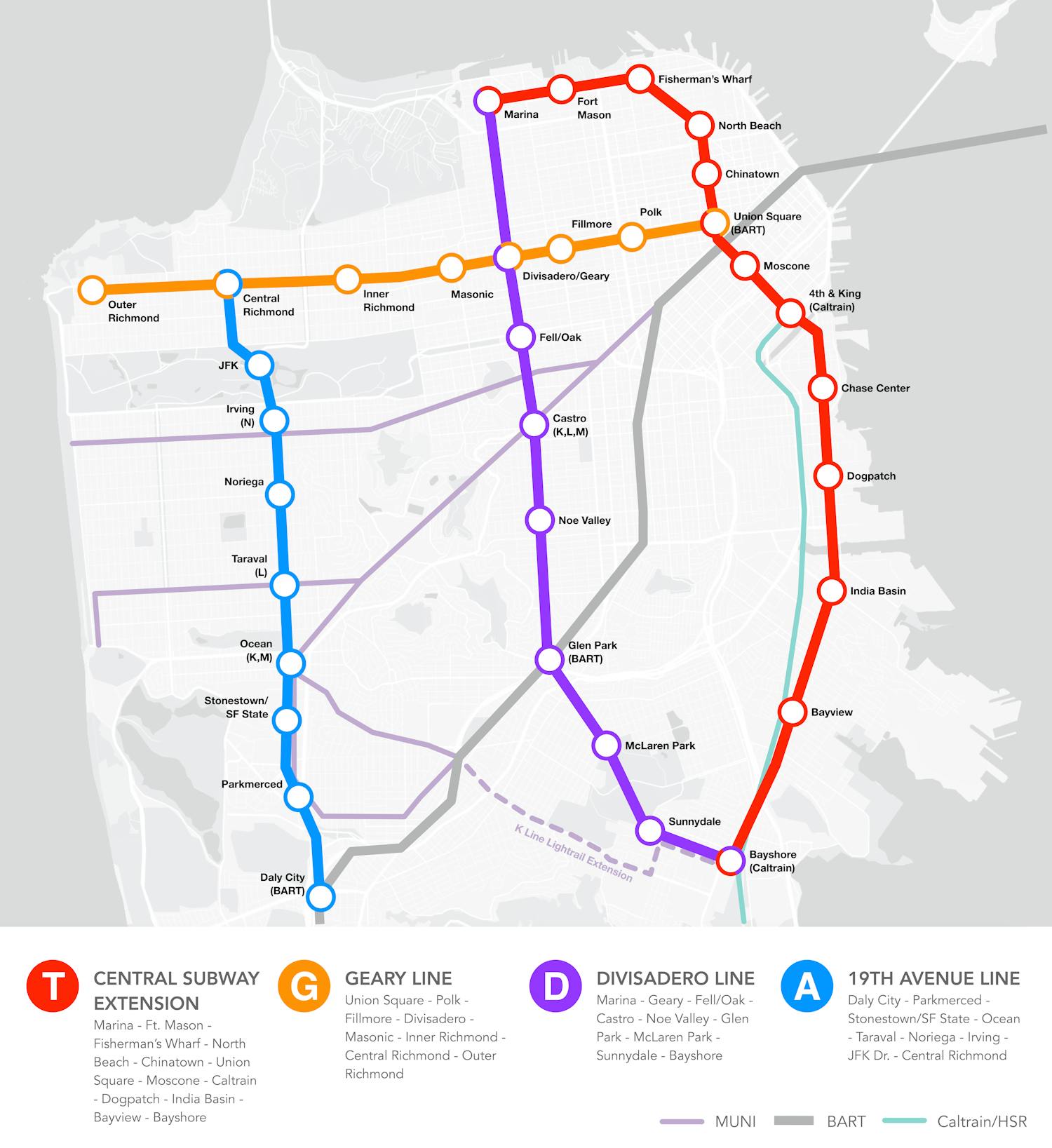
Preliminary Proposal
Extend the Central Subway and moving the whole T Line underground.
North to North Beach, Fisherman’s Wharf, and the Marina
South to 4th & King Caltrain, Chase Center, Dogpatch, Bayview, and Bayshore Caltrain
A Geary Line along Geary Blvd. from Union Square to the Outer Richmond
A Divisadero Line from the Marina to Glen Park, McLaren Park, and Bayshore Caltrain.
A 19th Ave Line along 19th Avenue from the Outer Richmond to Golden Gate Park, the Sunset, Stonestown/SF State, Parkmerced, and Daly City BART.
Getting It Done
Building a subway network at this scale would require San Francisco to address two major challenges: how to pay for it, and how to reduce the cost of building major transit infrastructure.
Building at a Cost San Francisco Can Afford
At approximately $1.15 billion per mile, the cost of San Francisco’s most recent subway construction, 24 miles of new underground subway would cost approximately $27.5 billion. We must do better.
Other cities around the world have shown that subway infrastructure can be built for far less. Spain has built subway projects at costs ranging from approximately $150 million to $350 million per mile.
If San Francisco could build this network at the high end of that range, a 24-mile system would cost approximately $8.4 billion. Affording a project of that cost would require major changes to the way San Francisco plans, manages, and builds large transportation projects.
Paying for the Network
Funding for a citywide subway network would come from a combination of federal, state, local, and private sources.
Federal funding, including grants through a reanimated Federal Transit Administration New Starts program, and low-interest Transportation Infrastructure Finance and Innovation Act (TIFIA) loans.
State and local funding, including revenue from a future congestion pricing program, aligned funding from shared high-speed rail stations, state infrastructure grants, and value capture through increased property tax revenue around each new station.
Private funding and investment through a new subway rail authority.
Changing How San Francisco Builds
Reducing construction costs would require major changes to the way San Francisco delivers large infrastructure projects.
Creating a dedicated subway-building authority. Establish a new and separate authority with permanent staff focused on building the subway network. The authority would coordinate among departments, procure materials, and manage major contracts.
Building multiple lines in sequence. Construct multiple lines continuously one after the other, so the same crews, machines, and engineers roll from one line to the next. Every segment gets faster and cheaper than the last, because the team that finishes it starts the next one the same year.
Automated and more frequent trains with smaller stations. Automated trains can run more frequently with shorter trains and smaller platforms. Smaller platforms allow for dramatically smaller stations that are easier, faster, and less costly to build.
Standardized designs. Use standardized station and train car designs throughout the system with manufactured components, reducing time and costs for both construction and maintenance.
Keep projects focused. Define the scope clearly and avoid unnecessary additions that increase costs.
Complete rigorous review before construction. Closely evaluate designs and bids before they are finalized in order to limit expensive changes once construction begins.
A Subway System for the Whole City
San Francisco is a compact city, but getting from one neighborhood to another can still take way too long.
This plan would connect more neighborhoods directly, reduce travel times, support housing near transit, and bring more people to commercial corridors across the city.
Building it would be a major undertaking. It would also require San Francisco to change the way it builds large public infrastructure. However, with the steps laid out in this plan, we can get it done affordably while creating good paying union jobs.
San Francisco is in need of a new generation of leadership with a bold vision for our future.
From housing to a state-of-the-art subway system, I want to help build a better San Francisco.
What do you think?
This is a campaign built on listening and action. Let us know what you think of the plan.